
Introducing
Arrow Chess
The whole chess world — and watching it should make you better. Every board of a live tournament on one screen, a momentum graph you can drag back to the move it turned, and a position read straight off a screenshot.
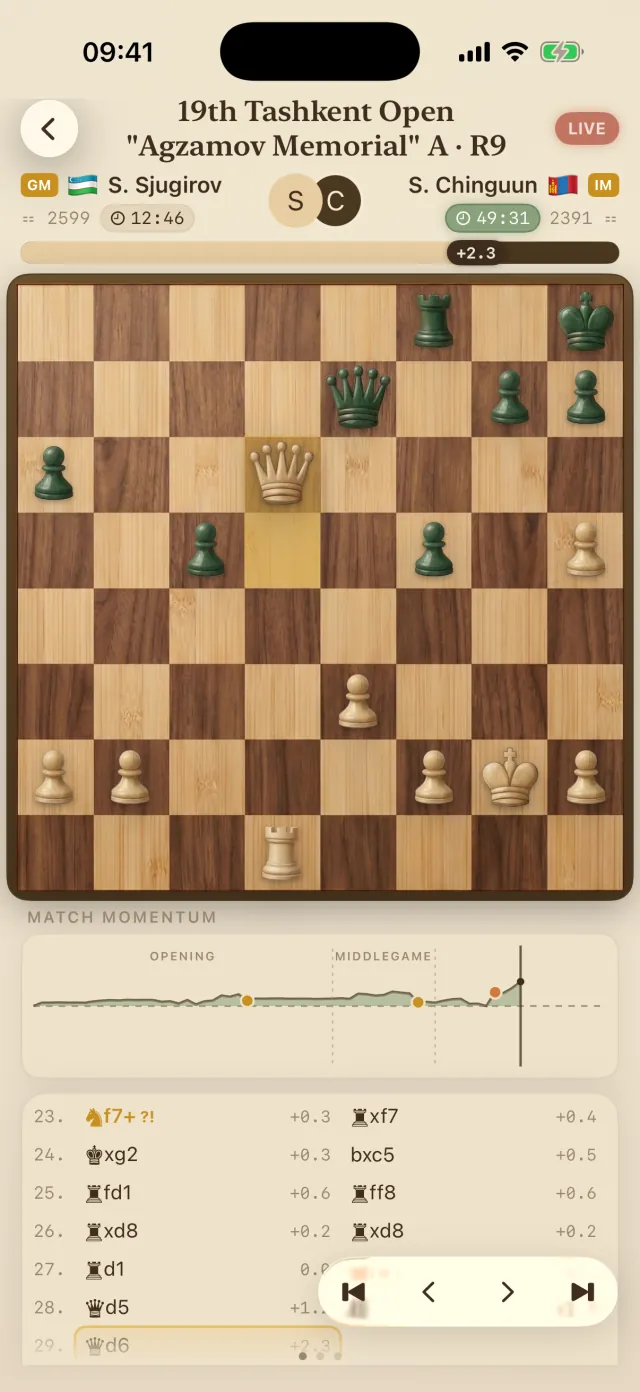
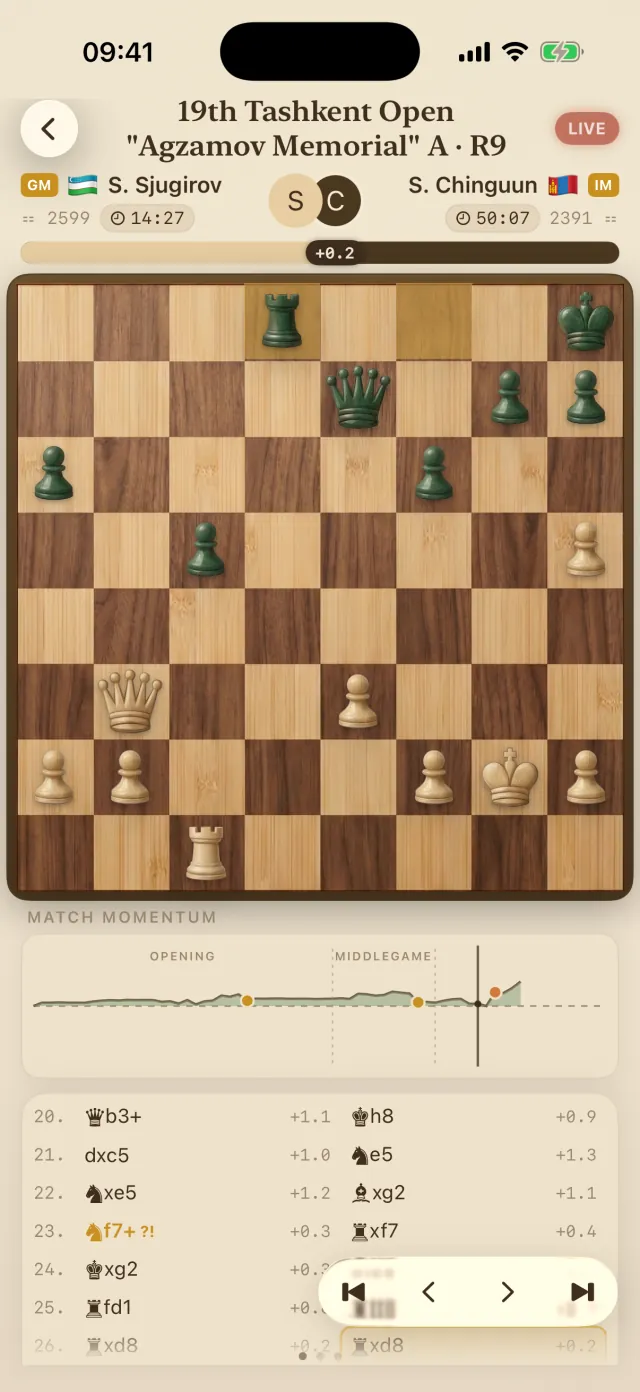
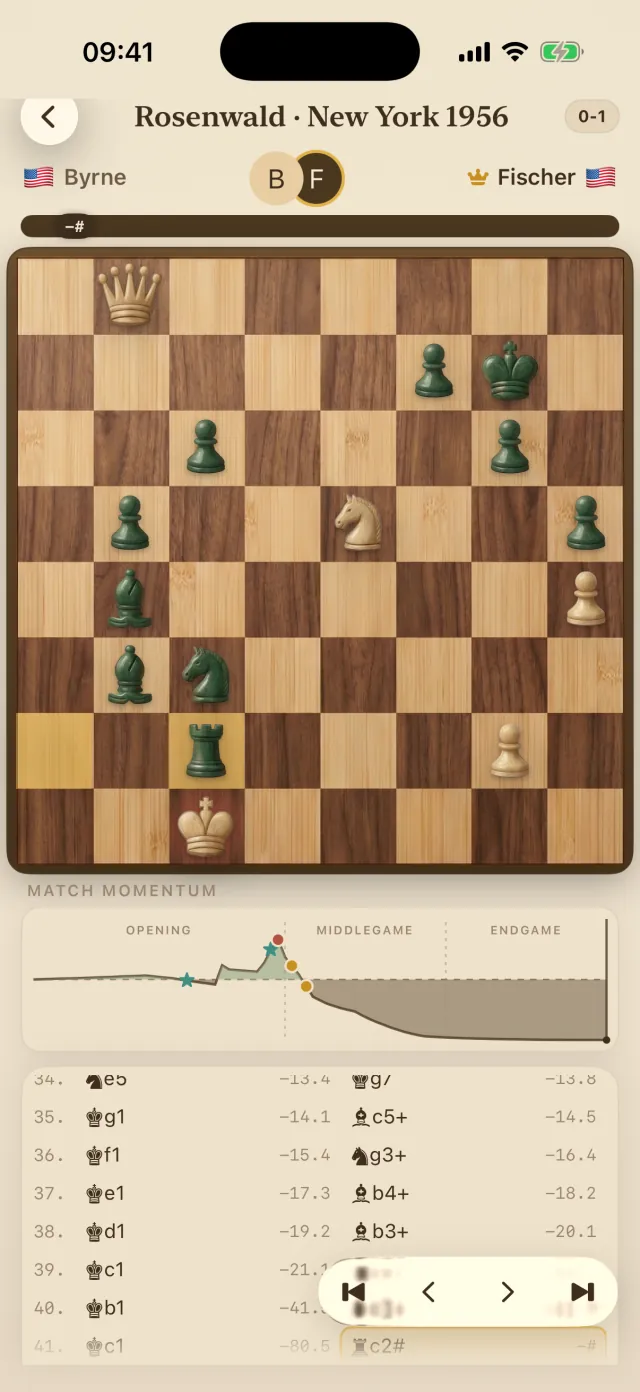
Captures from the iOS build running in the simulator. The games are real: Tashkent 2024 round 9, and Byrne–Fischer, New York 1956.
Watch
Every board of the round, on one screen
Open a tournament and you get the whole round at once — a grid of every board, each with its own running clocks, evaluation, names and federations. Tap one and it fills the screen. Nothing polls: the moves arrive on an open stream from our own relay, which reads the tournament feed, recovers the clocks, runs the engine and hydrates the opening before anything reaches your phone.
A finished game opens the same screen as a live one. That is not a coincidence — a test in the build asserts that the only visible differences are the LIVE chip and whether the clocks are ticking. There is no mode to learn and no second screen to go looking for.
- Match momentum — the win-chance curve for the whole game, partitioned into opening, middlegame and endgame, with the turning points marked. Drag it to move through the game.
- Honest surfaces — when a feed arrives without engine analysis, the evaluation bar and the graph simply are not drawn. The app never invents a number to fill a space.
- On the web too — the same backend serves live.arrowchess.com, so you can follow a round without installing anything.
Signature
Three things you will not find elsewhere
Point it at a screenshot
Share any screenshot containing a chessboard — a stream, a tweet, a book photo — and the app finds the board inside the full uncropped image and reads all sixty-four squares on the device. Nothing is uploaded.
Then it does the part that matters: it shows you the screenshot and the board it read, side by side, and rings every square it was unsure about in amber. You confirm or fix them before the position is accepted. A recogniser that hid its own doubt would be easier to build and worse to trust.
The trap of the day, with the receipts
Each day the app puts one opening trap on the home screen and lets you play the losing side into it, with a wall on the scrubber so you cannot spoil the punishment by skipping ahead.
Underneath is a histogram of who actually falls for it, by rating band. Those fall-in rates are measured over a swept corpus of real games, and the sweep is cited under the chart. It is the difference between “this is a nasty trap” and knowing that players rated like you walk into it.
An explorer scoped to this event
Opening explorers are usually global, or personal. This one can be scoped to the tournament you are watching: what these players, in this event, actually played, ranked by popularity with win, draw and loss splits — with the top games at each position ready to open in replay.
Train & play
The rest of it works offline
- Play a neural opponent with no server round-trip — a searchless action-value network runs on the device with five calibrated difficulty levels, on a plane or underground.
- Puzzles that adapt — build a set from motif filters and a rating band, work a review queue of the ones you missed, or take the day’s five-rung ladder.
- Search without a network — players, tournaments, series, openings and games are indexed on the device, aliases included, so “hoogovens” still finds Tata Steel.
- Player pages — rating timelines you can drag to inspect, on a true year axis with the peak annotated. A player we do not hold says so, rather than showing you somebody else’s numbers.
- Dress the board — hand-built themes and piece packs, previewed at both full size and multiboard size before you commit.
Underneath
We built the whole path
Most chess clients are a skin over somebody else’s feed. Arrow Chess runs its own: a Rust relay ingests the broadcast, repairs missing clock times, evaluates the positions and hydrates the openings, then fans the result out over a streaming connection to every client. The chess logic itself — rules, state, everything the screens are driven by — lives in one shared module compiled into the iPhone app, the Android app and the website alike, so the three cannot quietly disagree with each other.
Status
What is not ready
Arrow Chess has not been released, and we do not publish a launch date until a build has been submitted for review. Written commentary on games, event recaps and follow notifications are all built to varying degrees and none of them is switched on for users today, so none of them is claimed above. Everything on this page is a feature we can show working.
This is the same standard the rest of this site is held to: we do not claim what we have not measured.
Want to see it before it ships?
Press enquiries, and anyone who wants an early look, reach a mailbox we read. We reply from the same address.
[email protected]